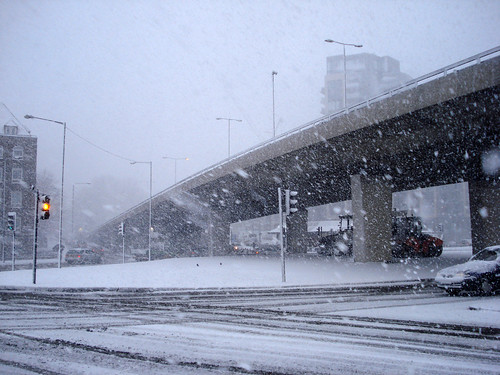
 CS2 isn't officially due to be operational until next Summer, but the latest of Boris's bank-sponsored cycle lanes is already making an appearance. A blue stripe has been daubed along parts of Bow Road and Mile End Road over the last week or two, and bikes are already speeding their way along. Sounds great? I'm not convinced.
 Olympic update
 Our latest local planning application is for a Vehicle Screening Area to be used during the Olympic Games in 2012. Organisers don't want any spectators turning up by car, but lots of vehicles still need to enter the park to make the Games work. Handymen to keep the place ticking over, deliveries of McDonalds burgers, visiting dignitaries in luxury coaches, that sort of thing. And it's clearly essential that none of these vehicles get inside the perimeter with a cargo of high explosive on board - hence the need for vehicle screening areas dotted around the edge of the park. We're getting one of these in Tower Hamlets. Squashed between the A12 and the River Lea, north of the mainline railway and south of Fish Island. Nowhere lovely, nowhere that'll be greatly missed. But planners still have to ask whether anybody minds, because that's the law.
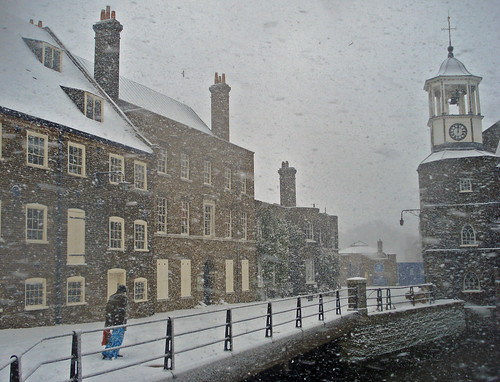
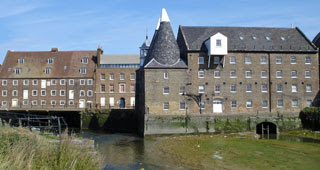 There are only two mills at Three Mills, although there used to be eight in medieval times. One survivor is the Clock Mill, so called it has a clock on the tower [photo], and the other is the House Mill, so called because the miller's house used to be nextdoor. The House Mill's the bigger, and dates back to 1776 in approximately its current form [photo]. It was built to grind grain not for flour but for the distillation of alcohol, most notably gin. All that came to an end one incendiary night during the Blitz, and it took sixty years for the mill to be rebuilt and restored. A fine upstanding body of volunteers maintain the site and open it up once a week (once a month in the winter) so that visitors can take a look around. It's busier than it could be, but not perhaps as busy as it should be.
 But it's the old mill you'll be wanting to explore. This is a splendid building, on several storeys, lovingly assembled from pine beams beneath a steeply pitched roof. Some of those beams are English Heritage replacements, but others (the chunkier, woodwormier ones) date back over 200 years. Health and Safety dictates you can't climb right to the top, but you can look up to see the wheel which hoisted sacks of grain to the high level bins. A series of hoppers and chutes directed the grain back down, ensuring it ended up between the right millstones at the right time, ready for the clunking machinery to whirr into action and get grinding. You have to watch your head lest you hit some wooden or metal protuberance, and watch your step in case you dislodge some trapdoor and open up a direct route to the floor below.
London 2012 Chairman, Sebastian Coe, said London's famous sights and settings will help to make the London 2012 Marathon a unique and unforgettable Olympic experience for all involved. "We wanted to design a course that will create lasting memories and moments for the runners, spectators, television audiences and the Olympic Movement; a course that will inspire a new generation of athletes and runners," said Coe, a double Olympic Gold medallist. (15 April 2005)The previous route, which made Seb all weak at the knees, wasn't much different to the revised route being touted around today. It started at Tower Bridge, then ran three identical loops down to Westminster and back, passing almost every iconic London landmark an international TV broadcaster could have desired [map]. Apart from the precise starting point, this concept of "three times round central London" hasn't changed. What has changed is that in the old version when the runners reached Aldgate for the third time they carried on, and ran up the A11 (aka HS2012, aka BCS2) to reach the Olympic Stadium. Because Olympic marathons always end at the Olympic Stadium. Even if that means, as in Athens in 2004, running along 'boring' peripheral roads lined with flats, shops and garages. London 2012 want to break the mould by ending in front of the Queen's house instead, and bollocks to tradition and to the East End.
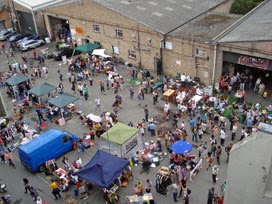 Where's the epicentre of East London's creative community? Brick Lane? More a tourist trap than an arts hub. Shoreditch? No longer as cool as it once thought it was. Try Hackney Wick. Its winding streets and graffiti-ed warehouses are home to more contemporary arty folk than you might expect, and this weekend they're throwing their doors open as part of the Hackney Wicked Festival. A damned impressive amount of cultural stuff is on show. More than 600 artists' studios are open (go on, any other part of London, beat that), and you're free to wander around and have a look. Just-painted canvases, quirky sculptures, mucky workdesks with nibbles on, that sort of thing. Some of the old buildings are more interesting than the art (sorry), including the opportunity to walk up three or four floors for a nice view over the Olympic Park. One gallery has bands playing on the roof, plus sofas for slouching in, plus astroturf and beer; another is hosting a fake church fete complete with tea and cakes. There are two main foci, one around Hackney Wick station and the other on Fish Island. In the former, it was great to see the derelict Lord Napier pub opened up, and Queen's Yard given over to a market with live music and food [homemade chocolate brownie from endearingly amateur bakers, tick]. In the latter, minor road closures gave rise to impromptu street parties, again with music, crafts and drink much in evidence [plastic beaker of Pimms poured by lady wearing lampshade, tick]. Forman's salmon smokery was open, with access to a roof terrace and the chance to look round their permanent top floor art gallery [smoked salmon bagel cooked by chef in the street, yum]. The whole event was packed with hipsters and beardykids, average age about 30 I'd have said, which made me feel a bit like I wasn't target audience. But I spent far longer looking round than I expected, and got to explore several non-pristine buildings I'd only ever walked past never dreaming I'd get inside. If you go today be warned that Hackney Wick station is closed, and that the event's website frequently collapses due to excessive demand. But never mind, just turn up and collect the excellent programme/map, and you won't miss a thing. Watch out in particular for the Coracle Regatta on the Lea (2-6pm), and a demonstration by the Hackney Wick Cold War Re-enactment Society (noon-3pm), and a closing procession to "Burn the Wicker Man" (ends 9:30pm). And pray that nobody ever sanitises and commercialises this end of town, because it's wicked as it is.
 Enter the University of Innsbruck. As part of the The International Student Architecture Festival, they asked architecture students to create some challenging artistic installations up and down High Street 2012. An innovative slatted staircase in Whitechapel, for one, and some guerilla gardening (in rubber gloves) along the Lea towpath north of the Bow Flyover [photo] [photo]. Stroudley Walk got Walk The Line, which was essentially the opportunity to slap a bright blue line across the pavement and see what happened. Simple and cheap, but would any of the locals react?
 The following day much of the line had degraded. The glue wasn't designed to be permanent, and passing footfall had dislodged several sections and left others flapping. The blue cloth had been moved so it didn't impede passing pushchairs heading to the pelican crossing. And in Stroudley Walk itself, the entire blue line had been ripped up and thrown into the square's recycling bins. The culprit could have been pesky kids, but I prefer to believe that some well-meaning cleaner assumed the line was vandalism not art, and dutifully removed the lot.
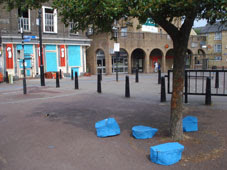 But the students had one last trick to encourage audience interaction. They'd brought along several simple 'added extras', all painted the same shade of vibrant blue, and dumped them liberally all over the square. A blue bookcase, with free books to take away. Four blue deckchairs under a blue umbrella. A blue dining table, plus seating. A blue noughts and crosses board with blue counters. Two billowing blue curtains with a gap inbetween labelled 'theater'. A square of blue chipboard (with a hole in it) dropped over a bollard to create a makeshift table. And lots of stumpy wooden trunks, painted blue, clustered to create areas of temporary seating. Success.
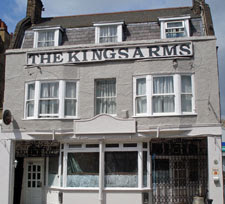 • Kings Arms update: I wrote last summer that the Kings Arms pub in Bow Road appeared to have closed down. The building then went very quiet until earlier this year when builders arrived and started doing the place up. I realised the worst - no more pub - when I peered in through the windows and saw partition walls and a staircase where the bar used to be. This week the new owners have even painted over the characterful "Kings Arms" lettering on the front of the building and replaced this with a wonky ill-judged aberration whose letters are already peeling off. The full name of the new business is only revealed in a tiny amateur sign in the window, inkjet-printed from a single sheet of A4 paper. This has been chopped into strips and stuck with tape not quite horizontally to the glass, and mutely announces the arrival of the "Kings Arms Guest House". As rebranding goes, this is woefully inept. The 2-star guest house has yet to open, but already has a web presence written by incompetents: "Kings Arms Guest House is a newly refurbished bughet accomodation that has excellent connectivity due to its prime location that suites to the Olympic Site officials working at Stratford, Banking & Business sector community of Canary Warf & Excel Centre and the tourists travelling to Central London visiting places." Another pub bites the dust, stripped and gutted to meet the 21st century business paradigm. Only the landlord of the Bow Bells opposite might raise a glass to that.