Title

News (and stuff) from London E3

Tuesday, 28 July 2009

The big topple

Rewind to Sunday, East London. Thousands of dominoes, scores of volunteers, one arty event. Part of the CREATE09 festival. A line of concrete breeze blocks running through Mile End, the Isle of Dogs and Greenwich. A moving sculpture. Or, as the blurb had it, "linking diverse communities in a symbolic as well as physical chain of cause and effect." Never mind that - the crowd who came to watch just wanted to see the whole lot fall down. Preferably, I suspect, by accident.

dominoes in Mile End ParkMile End Park, 3-ish
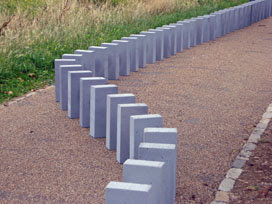
Approaching from afar, one lonely pallet of concrete blocks was the only clue that something was afoot. That and the lady stopping everyone cycling along the canal towpath in case they got in the way of the performance. But a hive of activity was hidden beyond the tennis courts, planned to within an inch of its life, as an army of t-shirted volunteers grappled with their unlikely raw material. 540 breeze blocks in total, laid out in a sinuous line along the footpath, across the grass and over the edge of a wall. Every 10th-or-so block had been placed lengthways rather than upright, to prevent any premature topplage causing the entire line to collapse. It rained.

Mile End Park, 3:30-ish
No sign yet of the signal for the off. A small crowd had gathered along the line, most of them near the start beneath the trees. One retired couple had brought a camera to record the magic moment, but had discovered to their cost that you can't replace a rechargable battery with an ordinary one. One of the lanky straggle-haired sportsmen hanging out on the tennis courts emerged to ask what all the concrete was for, and seemed duly impressed by the response. As time ticked by, the line was at increasing risk from volunteers and members of the public nipping oh-so-carefully across and through it. Only once did an accidental touch cause a block to wobble and fall, but the cascade didn't get far before a quick-thinking volunteer halted the flow. One especially elderly lady watched from a wheelchair, and waited, and waited, and nodded off, and had to be wheeled back to her flat without seeing a thing.

dominoes in Mile End ParkMile End Park, 4-ish
I could tell that the performance was finally imminent when the last gap across Copperfield Road was bridged with bricks. 'Get ready', yelled the man in the yellow waterproof, and his t-shirt army raised the 10% of blocker-blocks to the upright position. I had a good position lower down the line with a clear view of the snaking line. Or at least I did to start with. Once the first brick had tumbled and a merry cheer been raised, the crowd spontaneously followed the ripple downhill [video] [video]. They charged towards me, like a human tsunami, enveloping the phenomenon they were so keen to see. It was easy to outrun, so I could only work out roughly how far the topple had reached by observing which way the joggers were looking. At last it passed into near sight, each brick precisely knocking the next ...click click click click click click click... and I grabbed one underwhelming photograph click.

Mile End Park, 4:01-ish
At the edge of the park the first risky bit. The line passed through the railings, then a sheer drop down to street level, then across Copperfield Road and back up onto the pavement [video]. A carefully positioned block raised the flow up to doorstep height, then onward through the ground floor of Matt's Gallery. Unseen by the crowd it exited through a window along a beam above the canal, then fell into a boat conveniently tied up along the towpath. End of part one. Everybosy rushed round to the narrow road bridge to try to glimpse the boat as a few cracked blocks set off downstream. There'd be no more toppling for a few hours - this was no long unbroken domino chain - but momentum was maintained. The organisers smiled, job well done, and within 15 minutes all 540 blocks were back on their pallets.

Island Gardens, 6:30-ish: I didn't hang around to watch this bit. However, thanks to the wonders of the internet, I can offer you this photo and this video.

Greenwich Foot Tunnel, 9-ish: Nor this bit. Looked good though. Down the spiral staircase, along the edge of the tunnel and then (cor) up the other side.

Old Royal Naval College, 9:30-ish: Nor the finale. But I can tell it rained a lot, and it was a bit dark, and there were a lot more bricks.

A warehouse somewhere, autumn-ish: They'll be splicing together the entire performance to make a film, and then all the blocks are going back to the manufacturer to be be recycled. Ain't art fun?

Saturday, 25 July 2009

Dethroned

This is my local pub.
It's closed and shuttered.
"All items of value have been removed"
I wonder if it'll ever open again.

King's Arms, E3

There's been a Kings Arms in Bow Road since at least Victorian times. 140 years ago its Licensed Victualler was Ms Fanny Gear, a 46-year-old widow from Rotherhithe, 100 years ago Mr Elijah Morton, and 60 years ago Mrs Alice Berry. Millions of pints have been served over that time, mostly to very local people (because you wouldn't travel miles out of your way to sup here). The pub's little more than a large room with a bar in the centre, and a choice of entrances at the front. Saloon Lounge to the left, Saloon & Private Bar to the right, each name formed of golden letters within ornate ironwork above the door. There's been an Irish flavour to the pub of late, with Kilkenny cream ale and Guinness the favoured tipples. Regular karaoke nights brought in the punters, as did various signs on the pavement advertising Thai cuisine within. On sunnier days the patrons spilled out to sit at wooden tables in the slipstream of the A11, breathing in fumes and nattering above the relentless traffic. After closing time I'd often see the interior lit up, doors firmly bolted, as the beery cheery souls inside entertained themselves for a few more drunken hours. No longer, the pub's gone dark, gone silent, gone.

I never once went inside, of course. That's the problem with local pubs these days, lack of punters, lack of trade, lack of takings. Why go for a beer in your local pub when there are more interesting drinking holes elsewhere? Why pay three quid for a pint when cans are six for a fiver in the corner shop? Why patronise an alcohol dispensary when most of those living nearby are guided by their religion to be devout teetotalers? Hell, why support your local community pumproom at all, because wouldn't it look nicer converted into flats? And so pubs die, and convert, and disappear, and our neighbourhoods become residential hideaways where nobody ever meets up socially.

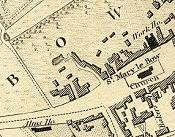
Bow VillageThe King's Arms wasn't always my local pub. There used to be several closer to my flat, clustered around the medieval heart of Bow village, all of them long gone. North of Bow Church the Three Tuns, Dog & Partridge and Coach & Horses (now McDonalds). South of Bow Church the Black Swan, Three Cups, White Horse and Bombay Grab (the latter, ironically, evolving into a mosque). So many E3 pubs have been erased, and in 2009 the King's Arms appears to have joined their number. It won't be the last. Raise a glass.

Activity for local people: I thought I'd have a go at mapping Bow's pubs - living and dead. I've used various useful historical and modern online resources to try to work out where the vanished ones were, and plotted them all on a Google Map. I've used blue pins for open pubs and red pins for closed pubs (although I might have got a few wrong). And if you know more than I do, the map's fully editable... so you can add some more pubs, add some information to the labels, even move the pubs around if you think I've put them in the wrong place. I've restricted myself to pubs within half a mile of Bow Church station, so please make sure you do too. And let's see what a collaboration of E3 alcoholics can come up with. [map]

Thursday, 25 June 2009

BW

RM2071Warning: minority interest post
Bow's buses are changing. Changing a bit, anyway. And I know that some of my readers actually live round here, and occasionally catch buses, and might care, so here's the heads-up.
Other readers may want to come back tomorrow, when I'll be visiting somewhere you've actually been.

Route 8: Bow Church - Victoria
It's five years this month since London's beloved Routemasters were withdrawn from Route 8, which kicks off in Bow. Five years on something else is being withdrawn, at the end of service tomorrow, and that's the last mile of the route. Number 8s have been chugging down to Victoria since 1992, but from Saturday they'll be stopping short and terminating at Oxford Circus. There's a good reason for this curtailment, apparently, which is that Oxford Street is seriously over-stuffed with buses. By stopping the number 8s short there'll be 20 fewer buses an hour clogging up the 500 metres of road between Oxford Circus and Bond Street stations, and every little helps. To make up for this break of service, and to ensure that buses still serve the middle of Mayfair, another route is being extended. Buses on Camden route C2 (which currently terminate at Oxford Circus) will now continue down to Victoria, carefully avoiding Oxford Street along the way. East London residents will then need to take two buses to get to Victoria, not one, which'll cost a few pay-as-you-go users twice as much. On the plus side, however, a shorter journey for the 8 ought to make the service more regular and reliable.

Route N8: Hainault - Victoria
The N8's also being cut back from Victoria to Oxford Circus. Need to get a night bus from Victoria to East London? Sorry, but from Saturday no single bus will take you further than Liverpool Street.

Route 15: Blackwall - Paddington
The 15 may not stop in Bow, but many of the fleet are currently based at Bow Bus Garage in Fairfield Road. Not after tomorrow, though. From Saturday they're all being transferred to West Ham Garage, a huge new complex built as overspill to make up for lost garages within the Olympic Park. Yes, I know, who cares. But...

RM1941 at Bow Church, June 2009Route 15 (heritage): Tower Hill - Trafalgar Square
TfL still run two Routemaster services, one of which is on route 15. Ten old buses are used to run the timetable, and the entire stock is currently held at Bow Garage. This means that the buses have to run empty into town from Bow in the morning, and trundle back to Bow at night. So if I'm ever outside my house at quarter past nine in the morning, there's often a big red Routemaster trundling by on its way to the City. The sight never fails to make me smile, because it means that RMs linger on in Bow even five years after they were officially culled. But not any more, not after tomorrow. On Saturday these heritage Routemasters are also being relocated to West Ham Garage. Off will come the "BW" plate outside the driver's cab, to be replaced no doubt by a less local "WH". And I'll never see these characterful workhorses chugging round Bow Church again, which is a damned shame. Ding ding.

Route 25: Ilford - Oxford Circus
It's five years tomorrow since bendy buses were first introduced on Route 25. Sorry, they're not changing at all. By rights the 5-year contract ought to be ending this weekend, but a two year extension means Boris can't remove Bow's bendies until at least 2011.

Route 205: Mile End - Paddington
And one bit of good news for local residents, but you'll have to wait a bit. At the moment there's only one bus that goes down Bow Road to central London and that's the 25. From 29th August there'll be another, because the 205 is being extended from Mile End to Bow Church. At last, a choice of bus that isn't bendy. At last, a choice of central London destination that isn't Oxford Circus. And (even better) the 205's a 24 hour service, so if you're staggering east to E3 after a heavy night out and the bendy 25s are full, at last there's an alternative. You lose some, you win some.

Friday, 12 June 2009

Nu-Bow

I went for a walk around the block yesterday. Quite a big block, from my home in Bow up one side of the A12 and down the other. And I was struck by quite how much new stuff there was. Things that weren't there when I moved to London eight years ago, but are now an integral part of the landscape. So I took some photos of some of the new stuff, which you can see a bit bigger by clicking on them, and I've written down a few thoughts. London's a-changing, some parts faster than others.

The Bow Flyover used to be the one of the tallest things around here, but not any more. A whopping great apartment block's been erected alongside, one of a chain along the Olympic borderline into Stratford, and still they come. This tower was only due to have nine storeys when the original planning permission went through, but greed and speculation raised it higher, and now there's a semi-let village hanging in the sky. In its shadow lurks a drive-in greasemonger selling stodge and fries, not an option eight years ago, but more than popular today. Rumour has it the local Baptist church may soon be reinstated alongside, no doubt slightly richer than before. Round here red and silver has replaced brown and grey, and there's no going back. [map]

Grove Hall Park's my local greenspace. It's nothing special, but its handful of grassy acres are more than pleasant all the same. The council's poured a load of money into the park over the last couple of years, sprucing up the memorial garden and adding a decent (and well-used) playground. There are tumbly slides for toddlers, geometric frames for kids and twin hoops for teens - a big improvement on the lacklustre selection on site before. Even the brightly painted garden wall has so far resisted the attention of the E3 spray-tagger posse. With fresh tower blocks poking up above a leafy canopy, this is the photo that most looks like it's an illustration from a town planner's brochure. I still can't quite believe it's real. [map]

Where did that shop come from? I'm sure last time I walked up Fairfield Road this was just an industrial unit awaiting rebirth, and suddenly it's a brand new convenience store. The people of Bow Quarter used to cope perfectly well with their own internal mini-market, but now there's another huge estate on the opposite side of the road it seems an additional shop can be supported. Its shelves are piled not-quite-high with lowest common denominator comestibles, with alcohol and fizzy drinks ranking higher in importance on the boards outside than fruit, bread and vegetables. Don't expect organic splendour, this is still the East End after all, and a packet of Haribo and some Lucozade will do quite well enough for many. [map]

Here's change in action. A nine-storey "contemporary development" is in the ascendant, but for now all you can do is pop into the sales centre and look at some pictures. Disappointingly the sales centre is based in a proper brick house (once the offices of HF Bates recycling yard), now hidden away behind enormous advertising banners, and a building with far more character than the pile of shiny boxes that'll replace it. Even worse, some marketing guru has labelled the entire project "Mojo", and has written some of the most complete tosh I've ever read to try and promote it. "Mojo is right where you want to be", apparently. Alas this end of Bow isn't "vibrant, full of contrasts and distinctly cosmopolitan", but is instead rapidly losing its soul to heritage-free building sites such as this. [map]

Not all redevelopment is bad. The area east of Parnell Road used to be covered by Soviet-style council blocks, and then the demolition teams moved in, and then the showhomes went up, and now there's an entire new community on site. At the heart is a long oblong green, with two giant poppies spouting in the centre, beneath which two- and four-legged friends hang out. Medium-sized flats surround the perimeter, each named after a god or goddess, and each with their respective cartoon image beaming down from the front wall. It's not quite so delightful beyond, where a solid ¼-mile wall of apartments flanks a roaring dual carriageway, dotted with tiny east-facing windows to keep the traffic noise at bay. The estate's brand new road network is considerably quieter. E3's local map is never static. [map]


The East Cross Route sliced through Bow in the early 1970s, and the community's been trying to join up the two sides ever since. Here in Old Ford is one of the few crossings, a 21st century footbridge designed to make Fish Island a slightly more accessible outpost to reach. It's a simple yet elegant hump, passing through a twisted ring of steel at its highest point, with separate (disregarded) lanes for pedestrians and bikes. To the west there's a grid of terraced houses plus corner shops and kids on bikes, while to the east there's a big yellow warehouse and a converted chapel and industrial bleakness. And viewable from the top, the steady stream of through traffic that created this social chasm in the first place. The first minor battle has been won. [map]

I fear that, one day, everybody in London will live in a tiny compartment on the site of something more interesting. Here's a case in point. This is Wick Lane, until recently a sidelined industrial outpost, before property developers deduced that high-rise living was worth far more than low-profit manufacturing. This pink-based block (on the site of a former dyeworks) was first to arise five years ago, its early residents isolated in the middle of social nowhere. The brochure for 417 Riverside (still available) promised "urban riverside living" (conveniently ignoring the sewer nextdoor) and offered "an attractive and accessible location" (maybe one day, definitely not yet). The neighbouring block appeared last year on the site of a newspaper ink factory - the end result a bland grey cuboid. Nah, sooner you than me. [map]

And the upgrade continues. The southern half of Fish Island, the chunk where the streets aren't named after dace, roach or bream, is (very) slowly evolving from grimy backwater to residential bubble. Making stuff is so very 20th century, so all the local jobs and places of employment are gradually shifting elsewhere. Come back in a few years and the JCBs will have moved on, the van hire yard will have disappeared and that boarded-up warehouse will have realised the potential of its residential footprint. Tomorrow's Islanders will be happiest working from home in their broadband-enabled studios, but they'll have to get their cars fixed somewhere else. Pack 'em in, pile 'em high, and erase all the stuff that made the area interesting in the first place. [map]

The northern half of Fish Island retains a little more character. Tower Hamlets recently slapped a conservation area around Dace Road, so this enclave of artist-packed warehouses and old factories (mmm, Percy's peanuts) should survive relatively unscathed. This photo shows the more modern Ironworks building, tightly squeezed into the courtyard of the feature it replaced. It's built right up close to the Greenway, access to which ought to be a simple hop off a balcony, but the site's single gated front entrance forces residents to make an unexpectedly lengthy detour. Expect the BBC or some other international TV company to take over the penthouse suite in three years time, because it's probably the very closest viewpoint to the final stop on my journey. [map]

A short stroll along the Greenway and there it is, the building that's acting as a catalyst for all this change in the surrounding borderlands. The newly-sprung Olympic Stadium is proving to be an irresistible magnet not just for sport but also for investment. There'll even be new homes erected right here, immediately in front of the stadium, come the post-Games legacy phase. As London's population grows, an even greater proportion of us are going to end up living in buildings that didn't exist at the turn of the century. Most of the new architecture I've passed on my walk would have sprung up anyway, but 2012 means that far more will follow in its wake. Olympic ripples are changing my neighbourhood, almost beyond recognition. [map]
Tuesday, 19 May 2009

The Euston Arch

Euston ArchOf all the acts of post-war architectural vandalism wreaked in the capital, few rankle quite so greatly as the wanton destruction of the Euston Arch. This towering Doric gateway stood in front of the original Euston station from 1837 until 1962, when it was unceremoniously demolished to make way for the characterless dingy shed from which trains to the northwest now depart. Many voices were raised in protest at the Arch's imminent demise, and snowballing public interest subsequently saved many a heritage building, but "progress" at Euston was alas unstoppable.
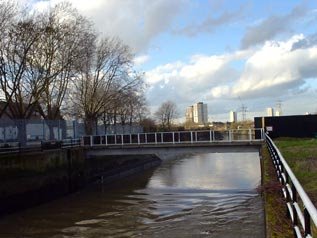
[Read more about the Arch and the campaign to restore it here. It's mighty detailed and interesting stuff, which I'm not going to repeat here]

But what do you do with 4420 tons of demolished arch? The chief contractor responsible for smashing the arch to bits was called Frank Valori, and he managed to find two particularly interesting hiding places for the dismembered stonework. One of these was his own back garden (at "Paradise Villa" in Kent) where a row of stones was used to create a fetching (and very cheap) terraced rockery. The other, rather more considerable, dumping ground was in Bromley-by-Bow in East London. British Waterways had problems with a scoured-out riverbed that needed infilling, so roughly 60% of the Euston Arch was dumped into the tidal waters of the Prescott Channel. And, hurrah, yesterday they started lifting the stones back out.
[Watch a 1993 programme about the dismantling of the Euston Arch, and Dan Cruickshank's hunt for the remains, here. Proper historical detective work it is, ending up in a rose garden]

footbridge across the Prescott ChannelYou'll know the southern end of the Prescott Channel well. It's one of the Bow Back Rivers, round the back of Three Mills Studios, and in the summers of 2000 and 2001 it appeared on your television every week. The first Big Brother house was built on the opposite bank to the TV studios, so every Friday the evicted housemate made their exit across the footbridge to reveal all to Davina. Yes, that river. Who'd have guessed there was a couple of thousand tons of dismembered railway arch in the waters directly underneath?
[Watch a 1994 programme where Dan Cruickshank (and Kevin the Diver) discover a chunk of Arch in the Prescott Channel, here. Blimey]

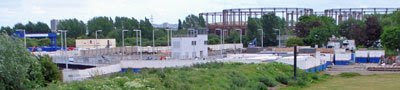
More recently the Prescott Channel has been the site of major Olympic development. In order to bring building materials into the Park by boat, a set of enormous lock gates is being constructed to stabilise water levels upstream. It's meant the temporary sealing off of three local footpaths, and the permanent demolition of Davina's Bridge, but the outcome might just be ecologically worthwhile.
[I wrote a long post about the new lock and the old Big Brother house here, so I won't repeat it all today]

lockside building site at Three Mills Green
Blimey it's taking a very long time to build the new Prescott Lock - considerably longer than originally planned. Construction began in March 2007 and was due to be completed "in summer 2008 in time for the main construction phase of the Olympic Park." Nope. The deadline later slipped to "autumn 2008", with landscaping of the surrounding riverbanks to be complete by "February 2009". Failed, on both counts. There's still a sprawling worksite on Three Mills Green, sealed off behind an unwelcoming wall, and there's no sign that anyone's even close to prettifying the scenery or re-laying turf. All three footpaths are still closed off, no longer with visible signs to indicate diversions nor anything to suggest when these riverbanks might reopen. At the moment they're still at the "dredging the river" stage, and this explains why the Euston Arch is finally being exhumed.
[You can flick through five year's worth of photos of the Prescott Channel here, courtesy of LoopZilla's Flickr account]

dredging on the Prescott ChannelI popped down after work to try to take a look at the site, but it wasn't easy. Riverside access to the Prescott Channel is still impossible, even if the tourist map outside the House Mill already shows a not-yet-complete configuration of new cross-lock footpaths. After a failed scout-round on all sides, perturbing more than one security guard in the process, I realised that the only decent view was to be had by train. And so it was, staring out of the window of a rattling Hammersmith & City line carriage, that I finally managed to catch sight of a lone dredger in the mud. All the workmen had gone home so no Doric chunks were being lifted out of the water while I sped by. But the lock gates looked sturdy and intact so, once the channel's finally been cleared of all underwater obstructions, there might eventually be some proper 2012 construction traffic heading this way. Better late than never.
[Read the British Waterways press release here]

Hurrah for the London Olympics, because without their sustainable transport policy the remains of the Euston Arch would have been doomed to a forgotten underwater life. As it is, this grand gateway may yet be reborn beside the Euston Road, where it ought to look bloody marvellous. One day.
[Just to check, you have clicked on the website of the Euston Arch Trust, haven't you? It's here, and it's excellent]

Saturday, 21 February 2009

George Lansbury (born 21 February 1859)

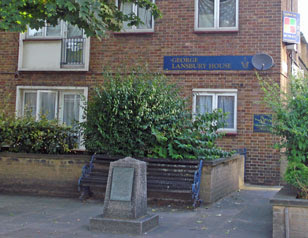
George Lansbury Memorial plaque, 39 Bow RoadThere are no prizes for being the Leader of Her Majesty's Opposition. You don't get to run anything, you're not really important, and nobody remembers you except as the answer to a pub quiz question. Which is why you lot probably aren't particularly well informed about George Lansbury, who was Leader of the Opposition for four years in the early 1930s. George was born exactly 150 years ago, which makes today a bit of a special anniversary. And he was also an East End bloke from Bow, and spent much of his life down my street, so this is an anniversary I feel is well worth celebrating.

Let me tell you ten things about 'Good old George' that you probably didn't know.

i) George was born in Halesworth, Suffolk - a market town so unexciting that George Lansbury is still its most famous resident.

ii) In his mid 20s, George and his young family emigrated briefly to Brisbane, Australia. George took various jobs to try to keep the family fed, including stone-breaking, slaughterhouse work and test match cricket ground maintenence. His antipodean experience of inequality and unemployment helped to shape his political beliefs.

iii) George's first political role was as General Secretary of the Bow & Bromley Liberal Association. From here he moved steadily leftward into radical trade unionism and Marxism, before joining the brand new Labour Party and becoming MP for Bow and Bromley in 1910. Two years later he resigned his seat to force a by-election over the issue of women's suffrage, and lost.

iv) Also in 1912, George was one of the founder members of the Daily Herald - a militant socialist daily newspaper. He steered the paper for the next ten years before handing over control to the TUC and Labour Party. The Daily Herald eventually metamorphosed into The Sun, whose post-Murdoch political slant would no doubt appal the left-wing radical who founded it.

v) In 1921, as Mayor of London's most poverty-stricken borough, George led the Poplar Rates Revolt. He was angry that richer boroughs weren't paying their share of relief to the poor, and so refused to pay £270,000 of local taxes to the London County Council. Thirty councillors were sent to prison for defying the courts, and Poplar Council business had to be conducted from inside Brixton prison.

vi) In 1927, back as Labour MP for Bow and Bromley, George joined the Cabinet as First Commissioner of Works. His many responsibilities included the Royal Parks, and it was he who created the mixed bathing 'Lansbury Lido' on the Serpentine.

vii) The 1931 General Election was the Labour Party's biggest ever landslide defeat. Only one member of the Cabinet kept his seat, and that was George, and so he became Leader of the 46-strong Opposition by default. Even in this lofty position he always travelled from Bow to Westminster by tube - part of a common touch that ensured he remained widely admired, even across party lines.

viii) George was a committed lifelong pacifist, and campaigned to disband the Army and disarm the Air Force. In any decade other than the 1930s he might have got away with it, but German militarisation left him increasingly out of step with reality. He was forced to resign as Labour leader, and took to campaigning for peace across Europe until his death in 1940.

39 Bow Roadix) Four years after George's death, his house at 39 Bow Road was destroyed by a German flying bomb. A block of council housing (and a plaque or two) now mark the site. George's name also lives on in Poplar's sprawling post-war Lansbury Estate, which featured as a Live Architecture exhibit during the Festival of Britain.

x) George has two very famous grandchildren - actress Angela Lansbury and animator Oliver Postgate.

Four special events are being held over the forthcoming week to celebrate George's life and work. The first is this afternoon...
» Saturday 21: Radical Bow - a history walk around Bow & Bromley led by the local vicar and George's biographer – meet at Bow Road station (2pm)
» Sunday 22: Memorial Service - conducted by the local vicar, with guest preacher Rev Dr Kenneth Leech and Monsignor Bruce Kent - at St Mary's Church, Bow Road (4pm)
» Wednesday 25: Panel discussion in Committee Room 4A at the House of Lords - featuring Roy Hattersley and Shirley Williams (arrive by 6.30pm to clear security)
» Friday 27: Panel discussion at Bromley Hall, Bow Road - featuring Tony Benn and Sylvia Pankhurst's biographer (7.30pm)

Wednesday, 4 February 2009

Merchant's Quarter

bus passing Merchant's QuarterAt six o'clock this morning a brand new supermarket opened in Bow. Fancy that, a brand new supermarket. It's halfway between Bow Road and Mile End tube stations, opposite the girls' school, next to St Clement's Hospital. A couple of years ago this spot was a narrow patch of greenspace sandwiched between Bow Road and a particularly unlovely council estate. Buddleia grew, white vans parked and stocky dogs squatted. Ripe therefore for acquisition by property developers, who noticed that they could squeeze a long thin apartment block into the gap. They built thin, they built high, and they built grey. The end result is a fortress of boxy apartments, shuttered behind what look like prison bars, in an architectural style I can only describe as ruddy ugly.
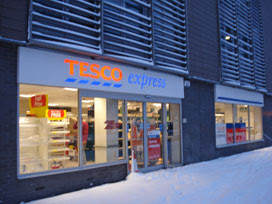
And on the ground floor there's a proper new supermarket. You probably haven't noticed it yet because it manifested itself very quickly. I only noticed last week when a single small sign saying "Store entrance →" appeared in a window on the ground floor. I had wondered whether this space might be for a row of shops but no, silly me, it's for a supermarket. I recognised the typeface immediately, so perhaps I wasn't quite so surprised that this particular national store chain had muscled its way into Bow under cover of a new housing development. Oh yes, retail homogenisation continues - we've got ourselves a new Tesco Express.

Bow's newest supermarketThey were stacking the shelves on Monday morning as I trudged past on my five mile wintry commute. Just the one bloke, by the looks of it - presumably the rest of the workforce were trapped elsewhere by catastrophic snow chaos. Signs reading "Half Price" and "Buy 1 Get 1 Free" were already in place, presumably pre-planned by whichever Tesco department has the job of fitting out a new supermarket in one week flat. There was rather more activity when I passed by at dawn yesterday morning. A fleet of contractor's vans was parked up on the extra-wide pavement, representing at least six different tradesmen essential to kickstarting a new business. One of these vans was for Rentokil. I also noticed a man on his knees inside the supermarket scurrying around behind where the tills are going to be. I'm not suggesting that these last two sentences are in any way connected, obviously.

And this morning, Bow's new Tesco Express is open. You can pop in and buy milk, rather than going to the small supermarket over the road beneath Minnie Lansbury's Clock. You can pop in and buy a newspaper rather than getting it from the nice family in the kiosk beside Bow Road station. You can pop in and buy six cans of lager rather than going for a beer at the Little Driver pub. You can pop in and buy paracetamol rather than getting it from the tiny pharmacy the other side of St Clement's Hospital. You can even pop in and buy fresh bread rather than getting it from Bow Supermarket just round the corner in Merchant Street. In short, you can pop in and help to kill off many of the independent shops in the neighbourhood, if you really insist. Which would be a damned shame. Do shop carefully (especially if you're living upstairs in one of the prison cells immediately above the frozen food cabinets).

Bow's never been well blessed with supermarkets, especially since Safeway on Roman Road closed down a few years ago. Sure there's the giant Tesco store at Three Mills, which is damned convenient for me, but quite a trek for those in the less well-off estates nearer Victoria Park. You'll find a Budgens under the Green Bridge and a mini Somerfield at the Bow Church Texaco, but there's no sign of a Sainsburys or a Lidl or an Asda. Does Bow exist in some sort of food desert? To find out I've knocked up a Google map to show all the major supermarkets in and around the E3 area. Local readers might find it of interest (or be able to pick holes in it). The new Tesco Express is represented by the yellow basket, then the surrounding pins show the paucity of supermarkets in E3 and beyond. Maybe turning the old Woolworths into an Iceland is exactly what the area needs...