Lutfur Rahman (Independent) 23283 (51.8%, elected)
Helal Abbas (Labour) 11254 (25.0%, humiliated)
Neil King (Conservative) 5348 (11.9%)
John Griffiths (Lib Dem) 2800 (6.2%)
Alan Duffell (Green) 2300 (5.1%)
Turnout: 25.6%
So a petition from 8% of the electorate
triggered a referendum in which 30% of the electorate
triggered an election in which 13% of the electorate
voted in an independent Mayor for Tower Hamlets.
Yesterday Labour ruled Tower Hamlets, with 63% of the councillors.
Today they still have 63% of the councillors, but no power.
Rarely has a core vote been deployed quite so effectively in the face of an apathetic electorate.
Friday, 22 October 2010
Thursday, 21 October 2010
Mayoral Election Day
Today is Mayoral election day in Tower Hamlets.
Alan or Helal or John or Lutfur or Neil.
Tough choice.
My polling card arrived several weeks ago along with an information pamphlet, and that was it. None of the candidates sent me anything else - not a leaflet, not a mailshot, not even a bar graph with arrows labelled "Cannot win here". There might have been some further background in Tower Hamlets' weekly council newspaper East End Life, but they don't bother sending me that any more. There was definitely some virulent propaganda in The London Bangla - a blatantly biased freesheet targeted on certain neighbourhoods in the borough. But I saw nothing targeted at me. It's a good job I remembered to vote anyway.
I normally vote on the way into work but this time I thought I'd vote on the way home. Rush hour, before it got dark, I emerged from Bow Road station to a barrage of leaflets. OK, so there were only two people handing out leaflets, but I made sure I took both. Only then did I discover I'd been given the same leaflet twice, once face up, once face down. Still, all credit to Labour for reminding homebound commuters that there was an election on, because I suspect most of them wouldn't have remembered otherwise.
My polling station's in a nearby school on Bow Road. Again there were canvassers outside, this time supporters of independent candidate Lutfur Rahman. But they were far too busy chatting to notice me wander up to the entrance, and completely failed to hand me one of their huge wodge of leaflets they had to give away. I picked one up out of the gutter on the way out, and saw that one side of the leaflet was an approximate copy of the ballot paper with a thumping big cross showing me precisely where to put my vote. A perfect pictorial representation for voters who don't follow written instructions, or spoken English, particularly well.
The polling station was not crowded. Indeed I was the only voter present, which I found surprising given the time of day. I was completely outnumbered by the five council scrutineers, two of whom dealt with me, and the rest of whom continued overseeing nothing. While they tried to cross my name off their list, I noted that only one other person on my sheet (out of about 50) had bothered voting during the previous 10 hours. Turnout up the slightly more affluent end of Bow looks likely to be rock bottom.
Not so nearby in Bromley-by-Bow. I passed the polling station in St Leonards Street at the end of the rush hour, after dark, and the pavement outside was seething. Canvassers, supporters, supporters of supporters, and a single policewoman keeping an eye on the lot. There was no unpleasant atmosphere and I was allowed to pass quite freely (indeed some of the folk with rosettes looked very disappointed when I didn't turn into the school playground as they'd hoped). But the contrast with my own polling station was stark. This was lively and animated, with the local Bangladeshi community considerably more engaged in the electoral process. Maybe that's because Helal Abbas lives just around the corner, but it wasn't only his followers massing outside.
I passed by one more time, half an hour before the polls closed. There were still umpteen political souls milling on the pavement outside the primary school, but now accompanied by two policemen. And a police van. And an unmarked police van. And even the Tower Hamlets CCTV van, parked up opposite to keep a recorded eye on proceedings. Did something kick off while I was away? Was there a big row between the Abbasers and the Rahmanites? No idea, but I've certainly never seen quite such a uniformed presence outside a polling station before.
Whatever the final Mayoral result, one thing seems clear. The final outcome will be decided by specific neighbourhoods that took great interest, and the apathetic will have do make do with whichever candidate those enthusiastic supporters select.
Alan or Helal or John or Lutfur or Neil.
Tough choice.
My polling card arrived several weeks ago along with an information pamphlet, and that was it. None of the candidates sent me anything else - not a leaflet, not a mailshot, not even a bar graph with arrows labelled "Cannot win here". There might have been some further background in Tower Hamlets' weekly council newspaper East End Life, but they don't bother sending me that any more. There was definitely some virulent propaganda in The London Bangla - a blatantly biased freesheet targeted on certain neighbourhoods in the borough. But I saw nothing targeted at me. It's a good job I remembered to vote anyway.
I normally vote on the way into work but this time I thought I'd vote on the way home. Rush hour, before it got dark, I emerged from Bow Road station to a barrage of leaflets. OK, so there were only two people handing out leaflets, but I made sure I took both. Only then did I discover I'd been given the same leaflet twice, once face up, once face down. Still, all credit to Labour for reminding homebound commuters that there was an election on, because I suspect most of them wouldn't have remembered otherwise.
My polling station's in a nearby school on Bow Road. Again there were canvassers outside, this time supporters of independent candidate Lutfur Rahman. But they were far too busy chatting to notice me wander up to the entrance, and completely failed to hand me one of their huge wodge of leaflets they had to give away. I picked one up out of the gutter on the way out, and saw that one side of the leaflet was an approximate copy of the ballot paper with a thumping big cross showing me precisely where to put my vote. A perfect pictorial representation for voters who don't follow written instructions, or spoken English, particularly well.
The polling station was not crowded. Indeed I was the only voter present, which I found surprising given the time of day. I was completely outnumbered by the five council scrutineers, two of whom dealt with me, and the rest of whom continued overseeing nothing. While they tried to cross my name off their list, I noted that only one other person on my sheet (out of about 50) had bothered voting during the previous 10 hours. Turnout up the slightly more affluent end of Bow looks likely to be rock bottom.
Not so nearby in Bromley-by-Bow. I passed the polling station in St Leonards Street at the end of the rush hour, after dark, and the pavement outside was seething. Canvassers, supporters, supporters of supporters, and a single policewoman keeping an eye on the lot. There was no unpleasant atmosphere and I was allowed to pass quite freely (indeed some of the folk with rosettes looked very disappointed when I didn't turn into the school playground as they'd hoped). But the contrast with my own polling station was stark. This was lively and animated, with the local Bangladeshi community considerably more engaged in the electoral process. Maybe that's because Helal Abbas lives just around the corner, but it wasn't only his followers massing outside.
I passed by one more time, half an hour before the polls closed. There were still umpteen political souls milling on the pavement outside the primary school, but now accompanied by two policemen. And a police van. And an unmarked police van. And even the Tower Hamlets CCTV van, parked up opposite to keep a recorded eye on proceedings. Did something kick off while I was away? Was there a big row between the Abbasers and the Rahmanites? No idea, but I've certainly never seen quite such a uniformed presence outside a polling station before.
Whatever the final Mayoral result, one thing seems clear. The final outcome will be decided by specific neighbourhoods that took great interest, and the apathetic will have do make do with whichever candidate those enthusiastic supporters select.
Wednesday, 6 October 2010
Three Mills
Britain's oldest, and largest, tidal mill is in Newham. But it's also in E3. It's the House Mill, at Three Mills. And it's open every Sunday afternoon if you fancy a look round.
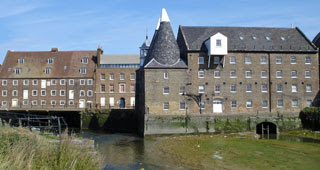 There are only two mills at Three Mills, although there used to be eight in medieval times. One survivor is the Clock Mill, so called it has a clock on the tower [photo], and the other is the House Mill, so called because the miller's house used to be nextdoor. The House Mill's the bigger, and dates back to 1776 in approximately its current form [photo]. It was built to grind grain not for flour but for the distillation of alcohol, most notably gin. All that came to an end one incendiary night during the Blitz, and it took sixty years for the mill to be rebuilt and restored. A fine upstanding body of volunteers maintain the site and open it up once a week (once a month in the winter) so that visitors can take a look around. It's busier than it could be, but not perhaps as busy as it should be.
Unlike most modern visitor attractions, the café and gift shop are located on the way in. You can have a sandwich or a toasted teacake while your tour guide gets ready, and maybe watch the introductory video (if you can hear the commentary above the hubbub of raucous diners). It's all endearingly amateur, even the unlikely second hand book stall in the corner, and all the better for it. Eventually you'll be heading off up the metal staircase which links together the old and the new parts of the mill. The miller's house turns out to be the wholly new part [photo], containing offices and a penthouse conference room, although from out the front it's a terribly convincing fake. Up top there's a fine view of the tidal river, and how it splits in half to feed the two different mills on the site. You also get some idea of the grand scale of the Three Mills film studios nextdoor, once all part of the same refinery complex, and apparently a former distribution centre for Bacardi.
 But it's the old mill you'll be wanting to explore. This is a splendid building, on several storeys, lovingly assembled from pine beams beneath a steeply pitched roof. Some of those beams are English Heritage replacements, but others (the chunkier, woodwormier ones) date back over 200 years. Health and Safety dictates you can't climb right to the top, but you can look up to see the wheel which hoisted sacks of grain to the high level bins. A series of hoppers and chutes directed the grain back down, ensuring it ended up between the right millstones at the right time, ready for the clunking machinery to whirr into action and get grinding. You have to watch your head lest you hit some wooden or metal protuberance, and watch your step in case you dislodge some trapdoor and open up a direct route to the floor below.
Eventually the tour reaches ground level, which is where the milled grain ended up and where the four waterwheels are. They're in two pairs, and also from completely different generations. The largest is a metal Victorian contraption, while the oldest is wooden and so fragile that the trustees daren't even touch it. All are controlled by their own sluice gate, and exist in a dark netherworld of decay and pigeon feathers. If there's ever any money going for further restoration, it's hoped that at least one of these wheels might turn again, powered as before by the ebbing tide. Alas, given that Newham can no longer spare any money even for local schoolchildren to come visiting, further regeneration may be several years off.
There are only two mills at Three Mills, although there used to be eight in medieval times. One survivor is the Clock Mill, so called it has a clock on the tower [photo], and the other is the House Mill, so called because the miller's house used to be nextdoor. The House Mill's the bigger, and dates back to 1776 in approximately its current form [photo]. It was built to grind grain not for flour but for the distillation of alcohol, most notably gin. All that came to an end one incendiary night during the Blitz, and it took sixty years for the mill to be rebuilt and restored. A fine upstanding body of volunteers maintain the site and open it up once a week (once a month in the winter) so that visitors can take a look around. It's busier than it could be, but not perhaps as busy as it should be.Unlike most modern visitor attractions, the café and gift shop are located on the way in. You can have a sandwich or a toasted teacake while your tour guide gets ready, and maybe watch the introductory video (if you can hear the commentary above the hubbub of raucous diners). It's all endearingly amateur, even the unlikely second hand book stall in the corner, and all the better for it. Eventually you'll be heading off up the metal staircase which links together the old and the new parts of the mill. The miller's house turns out to be the wholly new part [photo], containing offices and a penthouse conference room, although from out the front it's a terribly convincing fake. Up top there's a fine view of the tidal river, and how it splits in half to feed the two different mills on the site. You also get some idea of the grand scale of the Three Mills film studios nextdoor, once all part of the same refinery complex, and apparently a former distribution centre for Bacardi.
But it's the old mill you'll be wanting to explore. This is a splendid building, on several storeys, lovingly assembled from pine beams beneath a steeply pitched roof. Some of those beams are English Heritage replacements, but others (the chunkier, woodwormier ones) date back over 200 years. Health and Safety dictates you can't climb right to the top, but you can look up to see the wheel which hoisted sacks of grain to the high level bins. A series of hoppers and chutes directed the grain back down, ensuring it ended up between the right millstones at the right time, ready for the clunking machinery to whirr into action and get grinding. You have to watch your head lest you hit some wooden or metal protuberance, and watch your step in case you dislodge some trapdoor and open up a direct route to the floor below.Eventually the tour reaches ground level, which is where the milled grain ended up and where the four waterwheels are. They're in two pairs, and also from completely different generations. The largest is a metal Victorian contraption, while the oldest is wooden and so fragile that the trustees daren't even touch it. All are controlled by their own sluice gate, and exist in a dark netherworld of decay and pigeon feathers. If there's ever any money going for further restoration, it's hoped that at least one of these wheels might turn again, powered as before by the ebbing tide. Alas, given that Newham can no longer spare any money even for local schoolchildren to come visiting, further regeneration may be several years off.
Tuesday, 5 October 2010
CS2 - Bow to Aldgate
A month after dropping an introductory leaflet though our letterboxes, TfL have finally got round to publishing a map showing the route of Cycle Superhighway 2 - Bow to Aldgate. It's not a very detailed map, indeed we could all have guessed it would follow the A11 from along Whitechapel Hight Street, Whitechapel Road, Mile End Road and Bow Road. No surprise either that it'll link to the Regent's Canal towpath (or "cana towpath" as the key has it). Apparently there's going to be the provision of cycle parking at Bow Church DLR station. That must be new, surely, because I don't ever remember seeing any bikes padlocked up outside. And the Superhighway will terminate at the Bow Roundabout, rather than attempting to lure cyclists across several lanes of traffic and over the Bow Flyover. That elevated crossing may come later, once the Olympics are over, because nobody dares paint Stratford's roads blue before 2012. Expect to see roadworks and junction realignments along the A11 between now and next summer... but you'll have to wait to see precisely where that might be.
Saturday, 2 October 2010
E3 travel update
Run: The Olympic Marathon really isn't coming our way, is it? Not because we're ugly, nor because we're boring, but because we'd disrupt the special lanes of 2012 delegate traffic. Athletes and sponsors have to be able to get around town or else the Games seize up, so apparently it's for the greater good that 100-or-so athletes go running somewhere else. Personally, I don't get it. The road from Aldgate to Bow isn't part of the main Olympic Route Network - all the big limousines are to be directed down round via Poplar instead. There's a half mile overlap close to the stadium, between Bow and Stratford, but this is all dual carriageway and flyover so it'd be piss-easy to separate runners and vehicles. There'd be much more of a gridlock issue at the Tower Bridge end, Lord Coe has hinted, and that's the dealbreaker. But the road to Stratford doesn't start at Tower Bridge, so an eastbound marathon still ought to be perfectly possible. Most bastardly of all, the revised marathon route is then likely to head along Upper Thames Street and the Embankment ("heavily used every day of the Games with most extensive traffic management measures"). If the marathon can still shut three miles of Olympic Core Route in central London, what's the problem with a fraction of a mile further east? Dear Seb, if an announcement on the amputation of the East End's marathon is imminent, you'd better come up with a better excuse than this. A gold-medal-winning PR disaster awaits.
Rail: Good news, travellers. Crossrail looks likely to survive the upcoming slash'n'burn cuts, and will go ahead with all its stations and spurs intact. Which is great if you live in Maidenhead or Romford or Abbey Wood. But still of no use in E3. Ours is the only postcode along the entire route which Crossrail will tunnel under, but within which it won't stop. W1 and W2 get stations, and EC1 and E1, even E16, but not E3. Our nearest stations will be at least a mile away. None of the convenience, but of all the hassle of shaft-building and boring machines for several years. But you're right, who'd want to stop here anyway?
Walk: Boris's Story of London Festival started yesterday, and runs for ten days. There's only one event scheduled for E3, and even then only just. Blue Badge guides are leading £8 walking tours towards the Olympic Park, and they'll be setting off from Bromley-by-Bow station next weekend at 11am. Sounds great, except that these are pretty much the same £8 walking tours which set off from Bromley-by-Bow station every single day of every week. They're pretty popular, it has to be said, but they're by no means a special event put on for the Mayor's festival. If it's a unique local walk you want, I'd recommend the 14th Floor Project's free guided tours round nearby housing estates (being held in E2 and E14 next week) instead.
Rail: Good news, travellers. Crossrail looks likely to survive the upcoming slash'n'burn cuts, and will go ahead with all its stations and spurs intact. Which is great if you live in Maidenhead or Romford or Abbey Wood. But still of no use in E3. Ours is the only postcode along the entire route which Crossrail will tunnel under, but within which it won't stop. W1 and W2 get stations, and EC1 and E1, even E16, but not E3. Our nearest stations will be at least a mile away. None of the convenience, but of all the hassle of shaft-building and boring machines for several years. But you're right, who'd want to stop here anyway?
Walk: Boris's Story of London Festival started yesterday, and runs for ten days. There's only one event scheduled for E3, and even then only just. Blue Badge guides are leading £8 walking tours towards the Olympic Park, and they'll be setting off from Bromley-by-Bow station next weekend at 11am. Sounds great, except that these are pretty much the same £8 walking tours which set off from Bromley-by-Bow station every single day of every week. They're pretty popular, it has to be said, but they're by no means a special event put on for the Mayor's festival. If it's a unique local walk you want, I'd recommend the 14th Floor Project's free guided tours round nearby housing estates (being held in E2 and E14 next week) instead.
Tuesday, 28 September 2010
Starter for ten
Here are ten E3-related things I'd be interested in reading about...
• The Green Bridge - is it dying?
• Mile End station - seriously, which cretin thought this was an improvement?
• Which is E3's most heritage-tastic street?
• Are Tesco ever going to build that controversial store on Roman Road?
• Is Jongleurs worth a visit? Is it even still open?
• Gangs of E3 - is there a secret subculture?
• That new set of traffic lights outside the police station, useless or what?
• Whatever happened to the London Gas Museum?
• Tower Hamlets Cemetery Park - it's nice, innit?
• The new St Andrew's development - who'd buy a box in the sky?
...although I bet your list would be more interesting (and probably more relevant).
• The Green Bridge - is it dying?
• Mile End station - seriously, which cretin thought this was an improvement?
• Which is E3's most heritage-tastic street?
• Are Tesco ever going to build that controversial store on Roman Road?
• Is Jongleurs worth a visit? Is it even still open?
• Gangs of E3 - is there a secret subculture?
• That new set of traffic lights outside the police station, useless or what?
• Whatever happened to the London Gas Museum?
• Tower Hamlets Cemetery Park - it's nice, innit?
• The new St Andrew's development - who'd buy a box in the sky?
...although I bet your list would be more interesting (and probably more relevant).
Monday, 27 September 2010
Launch
I thought I'd start a hyperlocal blog of my own. I mean, why not? I've called it eethree (because ethree and e-three were already taken), and here it is. Don't get excited, there's nothing on here you haven't read on my main blog already. I've uploaded all my E3-related posts from the last couple of years to create a brief backstory, and now all that's missing is the new stuff. Maybe you'd help me write it.
I don't have time to maintain two blogs, not properly, so I'd be delighted if certain local folk could help me out with this new one. Let me know, and I'll add friendly literate authors to my eethree permissions list. Only news and comment from the E3 postcode will be permitted. That includes Mile End, Bow and Bromley-by-Bow, even Three Mills and Fish Island, but not Victoria Park or the Olympic Park. Please let's have nothing extreme, nor rampantly advertorial, nor anything applicable to Tower Hamlets as a whole. I reserve the right to moderate what gets churned out, or even to delete the entire project if it doesn't work. But let's hope eethree takes off. HyperEastEndlocality, it's the future you know.
I don't have time to maintain two blogs, not properly, so I'd be delighted if certain local folk could help me out with this new one. Let me know, and I'll add friendly literate authors to my eethree permissions list. Only news and comment from the E3 postcode will be permitted. That includes Mile End, Bow and Bromley-by-Bow, even Three Mills and Fish Island, but not Victoria Park or the Olympic Park. Please let's have nothing extreme, nor rampantly advertorial, nor anything applicable to Tower Hamlets as a whole. I reserve the right to moderate what gets churned out, or even to delete the entire project if it doesn't work. But let's hope eethree takes off. HyperEastEndlocality, it's the future you know.
Thursday, 23 September 2010
Snickers
WARNING: This post contains rude words and swearing. And justifiably so, I think.
The route of the 2012 Olympic marathon runs straight past my front door! How exciting is that?
But maybe not for much longer. There are mutterings, and rumours, and posturings which suggest that the marathon won't be coming my way after all. It won't pass through the East End, and it won't finish at the Olympic Stadium. Instead the Tower Hamlets arm will be amputated to allow the race to finish on the Mall instead. Which would be a bloody disgrace.
This decision isn't yet certain. Indeed Olympic chiefs haven't yet made any official announcement whatsoever. So I'll hold back from describing the organising committee as "a bunch of brand-obsessed fuckwits who don't give a toss about local communities", at least until the news is confirmed.
The new route, allegedly, runs three times round a circuit of Central London, both starting and finishing on the Mall. It'll pass such renowned London landmarks as Tower Bridge, St Paul's, Big Ben and Buckingham Palace, which should look lovely on TV and attract millions of extra tourists to visit our fair city. But it'll no longer pass Whitechapel Market, Mile End and the Bow Flyover because, by implication, they're shitholes unworthy of prime global airtime.
I am, to say the least, pissed off by this.
I've been very excited about the east-facing route of the London marathon ever since it was first announced. And I'm not the only one.
One especially feeble excuse being wheeled out is that this more compact course "enables spectators lining the route to watch the runners pass by several times." Pah, you devious fact-twisting bastards, the old route did that too. In fact the new route allows fewer people to watch the marathon than was previously planned, because the triple-loop still exists but nobody in East London gets to see the race at all. The Nu-Marathon looks like being a sanitised circuit race designed to minimise road closures, and all to avoid the Olympic Route Network clogging up. We can't have sponsors' limousines getting stuck in traffic, can we, because they're the priority.
And let's get this in perspective. A marathon is 26.2 miles long. The road from Aldgate to the Olympic Park in Stratford is 3.3 miles long. This means that TV broadcasters have kicked up a fuss about a mere 12½% of the marathon route. World class athletes should be able to run this distance in about 15 minutes. A couple of strategically placed commercial breaks should cover that, if TV bosses are really so paranoid about showing what they perceive to be uninterrupted kebab shops and council estates. To be honest, I think audiences might appreciate a few miles of something different after 1¾ hours of thrice-repeated landmarks.
All is not yet lost. A London 2012 spokeswoman said: "We have not yet confirmed all the details of the marathon route, we are in the process of finalising all the details and we hope to announce an approved route shortly." But if the final route castrates the East End, then half a million nearby residents are going to feel wholly cheated when marathon day comes round. And "a bunch of brand-obsessed fuckwits who don't give a toss about local communities" is going to be the mildest of my thoughts.
If London is really so ashamed of its East End, perhaps it shouldn't have built the Olympic Stadium there.
The route of the 2012 Olympic marathon runs straight past my front door! How exciting is that?
But maybe not for much longer. There are mutterings, and rumours, and posturings which suggest that the marathon won't be coming my way after all. It won't pass through the East End, and it won't finish at the Olympic Stadium. Instead the Tower Hamlets arm will be amputated to allow the race to finish on the Mall instead. Which would be a bloody disgrace.
This decision isn't yet certain. Indeed Olympic chiefs haven't yet made any official announcement whatsoever. So I'll hold back from describing the organising committee as "a bunch of brand-obsessed fuckwits who don't give a toss about local communities", at least until the news is confirmed.
The new route, allegedly, runs three times round a circuit of Central London, both starting and finishing on the Mall. It'll pass such renowned London landmarks as Tower Bridge, St Paul's, Big Ben and Buckingham Palace, which should look lovely on TV and attract millions of extra tourists to visit our fair city. But it'll no longer pass Whitechapel Market, Mile End and the Bow Flyover because, by implication, they're shitholes unworthy of prime global airtime.
I am, to say the least, pissed off by this.
I've been very excited about the east-facing route of the London marathon ever since it was first announced. And I'm not the only one.
London 2012 Chairman, Sebastian Coe, said London's famous sights and settings will help to make the London 2012 Marathon a unique and unforgettable Olympic experience for all involved. "We wanted to design a course that will create lasting memories and moments for the runners, spectators, television audiences and the Olympic Movement; a course that will inspire a new generation of athletes and runners," said Coe, a double Olympic Gold medallist. (15 April 2005)The previous route, which made Seb all weak at the knees, wasn't much different to the revised route being touted around today. It started at Tower Bridge, then ran three identical loops down to Westminster and back, passing almost every iconic London landmark an international TV broadcaster could have desired [map]. Apart from the precise starting point, this concept of "three times round central London" hasn't changed. What has changed is that in the old version when the runners reached Aldgate for the third time they carried on, and ran up the A11 (aka HS2012, aka BCS2) to reach the Olympic Stadium. Because Olympic marathons always end at the Olympic Stadium. Even if that means, as in Athens in 2004, running along 'boring' peripheral roads lined with flats, shops and garages. London 2012 want to break the mould by ending in front of the Queen's house instead, and bollocks to tradition and to the East End.
One especially feeble excuse being wheeled out is that this more compact course "enables spectators lining the route to watch the runners pass by several times." Pah, you devious fact-twisting bastards, the old route did that too. In fact the new route allows fewer people to watch the marathon than was previously planned, because the triple-loop still exists but nobody in East London gets to see the race at all. The Nu-Marathon looks like being a sanitised circuit race designed to minimise road closures, and all to avoid the Olympic Route Network clogging up. We can't have sponsors' limousines getting stuck in traffic, can we, because they're the priority.
And let's get this in perspective. A marathon is 26.2 miles long. The road from Aldgate to the Olympic Park in Stratford is 3.3 miles long. This means that TV broadcasters have kicked up a fuss about a mere 12½% of the marathon route. World class athletes should be able to run this distance in about 15 minutes. A couple of strategically placed commercial breaks should cover that, if TV bosses are really so paranoid about showing what they perceive to be uninterrupted kebab shops and council estates. To be honest, I think audiences might appreciate a few miles of something different after 1¾ hours of thrice-repeated landmarks.
All is not yet lost. A London 2012 spokeswoman said: "We have not yet confirmed all the details of the marathon route, we are in the process of finalising all the details and we hope to announce an approved route shortly." But if the final route castrates the East End, then half a million nearby residents are going to feel wholly cheated when marathon day comes round. And "a bunch of brand-obsessed fuckwits who don't give a toss about local communities" is going to be the mildest of my thoughts.
If London is really so ashamed of its East End, perhaps it shouldn't have built the Olympic Stadium there.
Sunday, 1 August 2010
Hackney Wicked
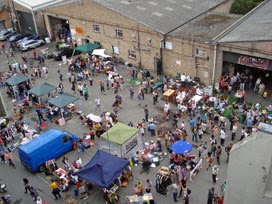 Where's the epicentre of East London's creative community? Brick Lane? More a tourist trap than an arts hub. Shoreditch? No longer as cool as it once thought it was. Try Hackney Wick. Its winding streets and graffiti-ed warehouses are home to more contemporary arty folk than you might expect, and this weekend they're throwing their doors open as part of the Hackney Wicked Festival. A damned impressive amount of cultural stuff is on show. More than 600 artists' studios are open (go on, any other part of London, beat that), and you're free to wander around and have a look. Just-painted canvases, quirky sculptures, mucky workdesks with nibbles on, that sort of thing. Some of the old buildings are more interesting than the art (sorry), including the opportunity to walk up three or four floors for a nice view over the Olympic Park. One gallery has bands playing on the roof, plus sofas for slouching in, plus astroturf and beer; another is hosting a fake church fete complete with tea and cakes. There are two main foci, one around Hackney Wick station and the other on Fish Island. In the former, it was great to see the derelict Lord Napier pub opened up, and Queen's Yard given over to a market with live music and food [homemade chocolate brownie from endearingly amateur bakers, tick]. In the latter, minor road closures gave rise to impromptu street parties, again with music, crafts and drink much in evidence [plastic beaker of Pimms poured by lady wearing lampshade, tick]. Forman's salmon smokery was open, with access to a roof terrace and the chance to look round their permanent top floor art gallery [smoked salmon bagel cooked by chef in the street, yum]. The whole event was packed with hipsters and beardykids, average age about 30 I'd have said, which made me feel a bit like I wasn't target audience. But I spent far longer looking round than I expected, and got to explore several non-pristine buildings I'd only ever walked past never dreaming I'd get inside. If you go today be warned that Hackney Wick station is closed, and that the event's website frequently collapses due to excessive demand. But never mind, just turn up and collect the excellent programme/map, and you won't miss a thing. Watch out in particular for the Coracle Regatta on the Lea (2-6pm), and a demonstration by the Hackney Wick Cold War Re-enactment Society (noon-3pm), and a closing procession to "Burn the Wicker Man" (ends 9:30pm). And pray that nobody ever sanitises and commercialises this end of town, because it's wicked as it is.
Friday, 2 July 2010
LFA 2010
The London Festival of Architecture hit my bit of town last weekend. Up and down High Street 2012, from Aldgate to Stratford, a series of building-worthy events and installations to celebrate the East End's architectural creativity. And one of those events was really close to home, in the unlikely locale of Stroudley Walk, E3.
If you don't live around here, all you need to know is that Stroudley Walk is post-war-grim. A windswept piazza lined by bottom-of-the-heap retail units. A boarded-up pub in the shadow of a squat tower block, and a chippie I'm not convinced sells cod any more. An echoing void with space enough for a complete market, where only one single stall-trader sets up shop. It's nowhere to linger, unless you've got some cheap alcohol and the entire day to spare. Socially speaking, Stroudley Walk's an architectural disaster.
 Enter the University of Innsbruck. As part of the The International Student Architecture Festival, they asked architecture students to create some challenging artistic installations up and down High Street 2012. An innovative slatted staircase in Whitechapel, for one, and some guerilla gardening (in rubber gloves) along the Lea towpath north of the Bow Flyover [photo] [photo]. Stroudley Walk got Walk The Line, which was essentially the opportunity to slap a bright blue line across the pavement and see what happened. Simple and cheap, but would any of the locals react?
The blue line went down a week ago. The students painted glue all the way along Bromley High Street, then painstakingly walked along and stuck a thick strip of blue tape over the top. At the junction with Bow Road they draped a roll of blue cloth along the railings of the gents conveniences, and tied the top end to Mr Gladstone's right hand. All in all surprisingly effective [photo]. And then they went back to their lodgings for the evening.
 The following day much of the line had degraded. The glue wasn't designed to be permanent, and passing footfall had dislodged several sections and left others flapping. The blue cloth had been moved so it didn't impede passing pushchairs heading to the pelican crossing. And in Stroudley Walk itself, the entire blue line had been ripped up and thrown into the square's recycling bins. The culprit could have been pesky kids, but I prefer to believe that some well-meaning cleaner assumed the line was vandalism not art, and dutifully removed the lot.
Over the weekend Mr Gladstone's ribbon was unceremoniously chopped, leaving no line to walk, only a short strip of fabric dangling in mid-air. But the students had a better idea for a more durable line elsewhere. They used blue paint this time, and progressed along Stroudley Walk putting out branches to various features along the way. A 'postcard' branch to the post office, a 'market' branch to the fruit & veg stall, that sort of thing, adding a little complexity to the project. But the local populace were unmoved. They walked straight through the area as normal, especially the adults, even the kids, I suspect because nobody quite understood what was going on.
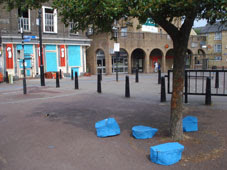 But the students had one last trick to encourage audience interaction. They'd brought along several simple 'added extras', all painted the same shade of vibrant blue, and dumped them liberally all over the square. A blue bookcase, with free books to take away. Four blue deckchairs under a blue umbrella. A blue dining table, plus seating. A blue noughts and crosses board with blue counters. Two billowing blue curtains with a gap inbetween labelled 'theater'. A square of blue chipboard (with a hole in it) dropped over a bollard to create a makeshift table. And lots of stumpy wooden trunks, painted blue, clustered to create areas of temporary seating. Success.
Local residents paused, and stopped, and lingered. A bunch of teenagers sat around on the blue tree trunks and chatted. The lady from the dry cleaners rested on some blue wood while she had a fag. Merry lager-drinkers settled at the blue table to lap up beer and sunshine. The theatre remained empty, from what I saw, because that was probably culturally over-adventurous for round here. But it was great to see the area temporarily transformed into "a place accommodating social interaction." It's taken a bunch of Austrian students to point out that Stroudley Walk lacks a beating heart, and that communal renaissance could be kickstarted by something as simple as a few cheap benches and a bit of imagination.
• Loopzilla's Walk The Line Flickr photoset
• Plans to revitalise Stroudley Walk (i.e. build more homes and a new tower block)
• The London Festival of Architecture concludes this weekend (at Bankside Urban Forest)
If you don't live around here, all you need to know is that Stroudley Walk is post-war-grim. A windswept piazza lined by bottom-of-the-heap retail units. A boarded-up pub in the shadow of a squat tower block, and a chippie I'm not convinced sells cod any more. An echoing void with space enough for a complete market, where only one single stall-trader sets up shop. It's nowhere to linger, unless you've got some cheap alcohol and the entire day to spare. Socially speaking, Stroudley Walk's an architectural disaster.
Enter the University of Innsbruck. As part of the The International Student Architecture Festival, they asked architecture students to create some challenging artistic installations up and down High Street 2012. An innovative slatted staircase in Whitechapel, for one, and some guerilla gardening (in rubber gloves) along the Lea towpath north of the Bow Flyover [photo] [photo]. Stroudley Walk got Walk The Line, which was essentially the opportunity to slap a bright blue line across the pavement and see what happened. Simple and cheap, but would any of the locals react?The blue line went down a week ago. The students painted glue all the way along Bromley High Street, then painstakingly walked along and stuck a thick strip of blue tape over the top. At the junction with Bow Road they draped a roll of blue cloth along the railings of the gents conveniences, and tied the top end to Mr Gladstone's right hand. All in all surprisingly effective [photo]. And then they went back to their lodgings for the evening.
The following day much of the line had degraded. The glue wasn't designed to be permanent, and passing footfall had dislodged several sections and left others flapping. The blue cloth had been moved so it didn't impede passing pushchairs heading to the pelican crossing. And in Stroudley Walk itself, the entire blue line had been ripped up and thrown into the square's recycling bins. The culprit could have been pesky kids, but I prefer to believe that some well-meaning cleaner assumed the line was vandalism not art, and dutifully removed the lot.Over the weekend Mr Gladstone's ribbon was unceremoniously chopped, leaving no line to walk, only a short strip of fabric dangling in mid-air. But the students had a better idea for a more durable line elsewhere. They used blue paint this time, and progressed along Stroudley Walk putting out branches to various features along the way. A 'postcard' branch to the post office, a 'market' branch to the fruit & veg stall, that sort of thing, adding a little complexity to the project. But the local populace were unmoved. They walked straight through the area as normal, especially the adults, even the kids, I suspect because nobody quite understood what was going on.
But the students had one last trick to encourage audience interaction. They'd brought along several simple 'added extras', all painted the same shade of vibrant blue, and dumped them liberally all over the square. A blue bookcase, with free books to take away. Four blue deckchairs under a blue umbrella. A blue dining table, plus seating. A blue noughts and crosses board with blue counters. Two billowing blue curtains with a gap inbetween labelled 'theater'. A square of blue chipboard (with a hole in it) dropped over a bollard to create a makeshift table. And lots of stumpy wooden trunks, painted blue, clustered to create areas of temporary seating. Success.Local residents paused, and stopped, and lingered. A bunch of teenagers sat around on the blue tree trunks and chatted. The lady from the dry cleaners rested on some blue wood while she had a fag. Merry lager-drinkers settled at the blue table to lap up beer and sunshine. The theatre remained empty, from what I saw, because that was probably culturally over-adventurous for round here. But it was great to see the area temporarily transformed into "a place accommodating social interaction." It's taken a bunch of Austrian students to point out that Stroudley Walk lacks a beating heart, and that communal renaissance could be kickstarted by something as simple as a few cheap benches and a bit of imagination.
• Loopzilla's Walk The Line Flickr photoset
• Plans to revitalise Stroudley Walk (i.e. build more homes and a new tower block)

• The London Festival of Architecture concludes this weekend (at Bankside Urban Forest)
Subscribe to:
Posts (Atom)